Green Infrastructure Credit in Stormwater Detention Calculations
How to match GI credit to the design objective and rules.

Green infrastructure credit in stormwater detention calculations is an objective-specific input. Accurate, defensible sizing depends on matching the credit mechanism to the design objective, measuring the right contribution, and applying the governing rules. A practice’s presence alone does not establish how much conventional detention it can replace.
What GI credit actually is and what it does in a detention calculation
A designer who installs bioretention must still decide how to represent it in the detention calculation. The facility may retain runoff, treat water that passes through it, or do both, depending on how it is configured. Those distinctions determine what the calculation can claim. Green infrastructure, or GI, credit is the regulatory mechanism that allows qualifying on-site practices to reduce the required detention volume or the calculated peak discharge rate used in sizing a conventional facility. It translates a qualifying function into a defined calculation input.
That credit is not a blanket reduction. The same practice may earn different credit for water quality, channel protection, and flood control because each objective measures a different part of how it handles stormwater. A defensible calculation therefore connects the installed practice to the specific requirement it offsets. Without that connection, even correct arithmetic can give the wrong detention size.
How the calculation objective determines which credit mechanism applies
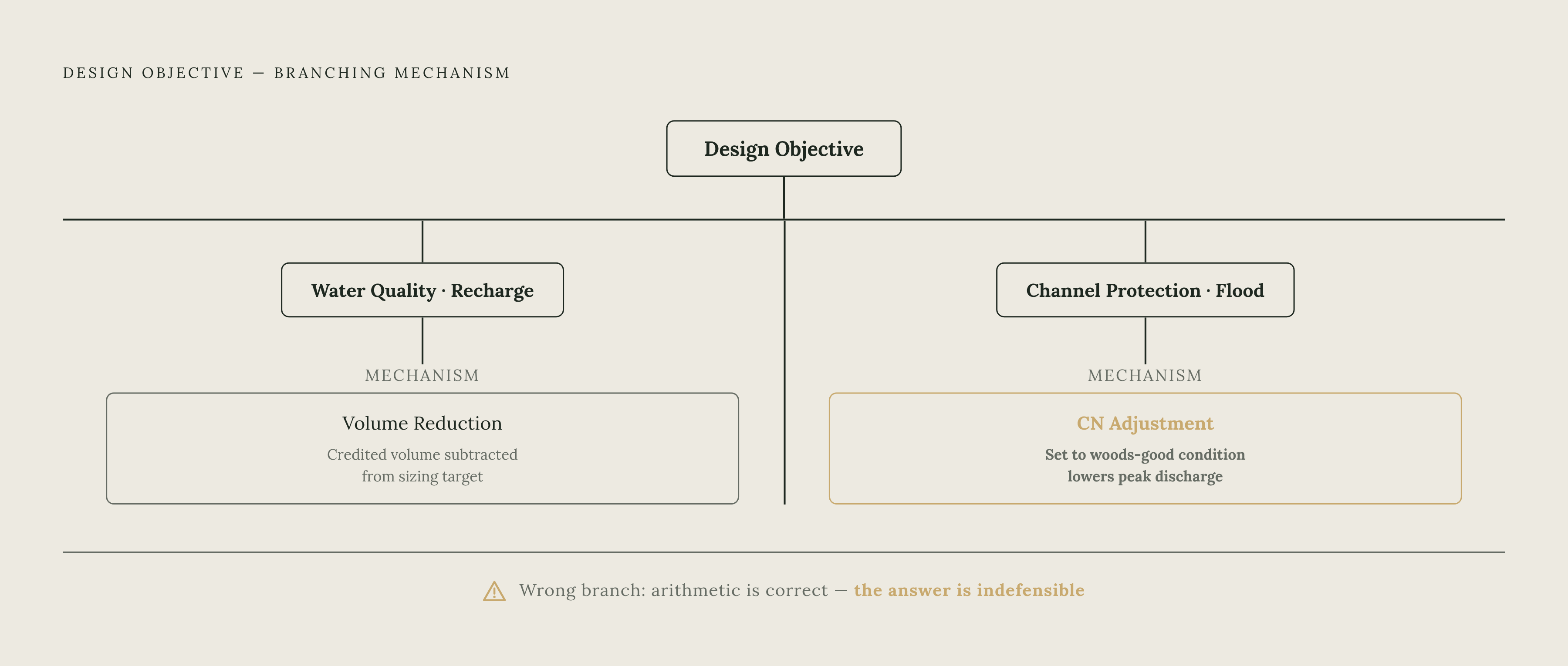
The first branch in the calculation is the objective. For water quality and recharge objectives, credit typically reduces the required treatment or infiltration volume directly. The credited volume is subtracted from the applicable sizing target. For channel protection and flood control objectives, the mechanism instead adjusts the runoff curve number for the credited area to that of woods in good condition. That change lowers the calculated peak discharge rate used to size the facility.
These mechanisms answer different questions about runoff. A volume reduction accounts for water retained or infiltrated, while a curve number adjustment changes the runoff calculation for the credited area. They are not interchangeable simply because both can reduce conventional detention needs. Applying a volume credit to a peak-flow sizing calculation, or a curve number adjustment to a water quality volume requirement, produces an indefensible result. The engineer must establish the objective before selecting the formula, then evaluate the practice under the mechanism that applies to it.
What each major GI practice earns credit for, and how that credit is measured
Bioretention credit is measured per gallon retained, but the underdrain configuration determines which water qualifies. Minnesota’s Stormwater Manual separates the volume-credit methods for systems with and without underdrains because their pollutant removal pathways and volume-reduction functions differ. Bioinfiltration has no underdrain and relies primarily on infiltration. Water fully infiltrated achieves complete volume reduction. Biofiltration has an underdrain and serves primarily as a water quality control, with volume reduction limited to infiltration below the underdrain and evapotranspiration.
Pretreatment is a prerequisite for that credit claim. All bioretention facilities require pretreatment before runoff enters the best management practice, and its absence disqualifies the claim regardless of the calculated retention volume. Permeable pavement has a different measurement basis, with credit expressed per square foot replaced. The manual limits its volume credit to runoff fully contained in the stone reservoir and subbase that will ultimately infiltrate into the soil subgrade. Total reservoir capacity is therefore not the credited volume.
Other practices use distinct units as well. Green roof credit is based on each square foot installed, detention pond credit on each cubic foot of capacity, and rain garden credit on each gallon processed. These units identify the quantity being credited, but they do not make the practices interchangeable. A pavement area, a pond capacity, and a retained volume cannot substitute for one another without the applicable practice-specific calculation.
Why the area draining to GI — not the GI footprint — is the controlling variable in credit magnitude
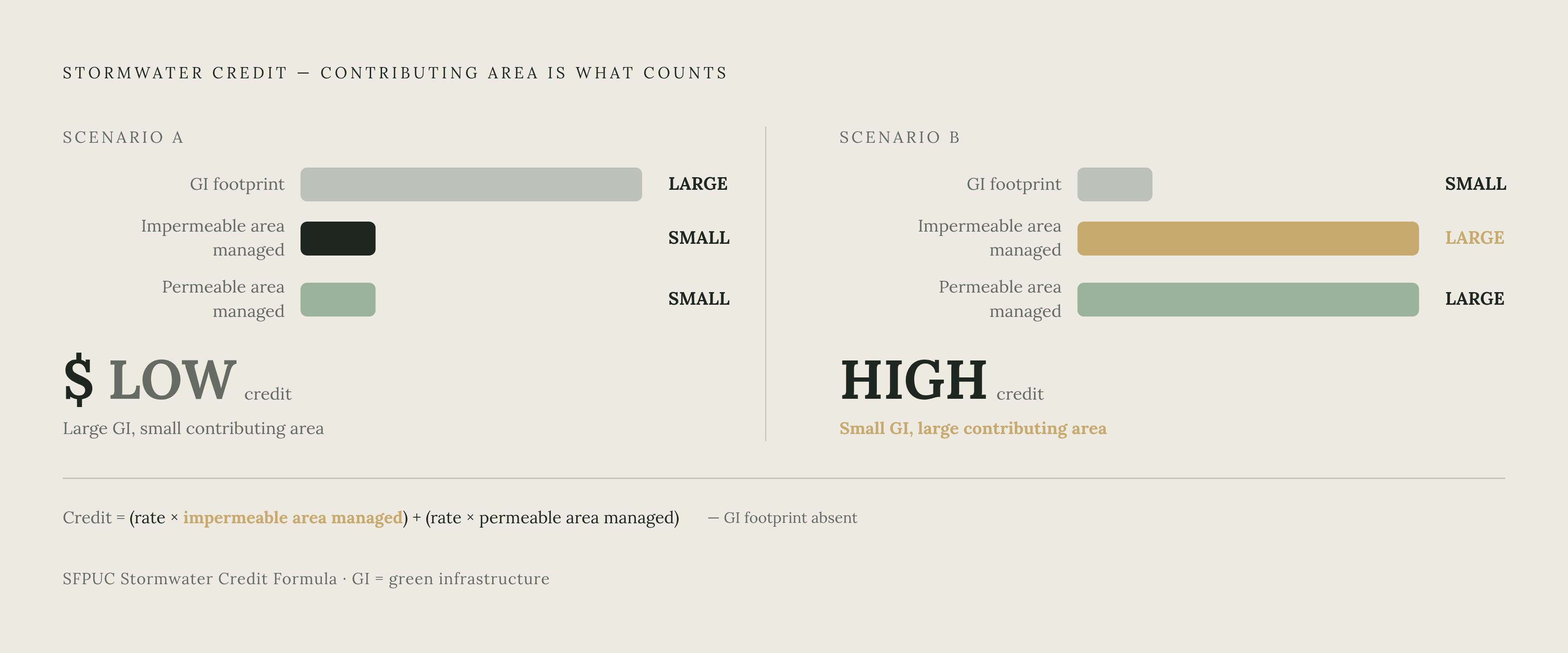
SFPUC’s Stormwater Credit Guidebook states that the impermeable area draining to GI is the main factor in its simplified residential credit calculation, while the GI footprint is not part of the formula. The distinction is direct and consequential for documentation. Under that method, a larger rain garden that manages a smaller contributing impermeable area earns less credit than a smaller rain garden that manages a larger contributing impermeable area.
The guidebook’s standard rate formula calculates Stormwater Credit as the sum of two products, namely impermeable area rate multiplied by impermeable area managed by GI, and permeable area rate multiplied by permeable area managed by GI. Practice dimensions appear nowhere in that expression. Impermeable area earns much more credit per unit area, so errors in delineating those surfaces have the greatest effect on cost. The guidebook also caps the credit at 90% because fixed costs remain and GI does not capture all runoff. This is a stormwater charge credit, so neither the formula nor its cap establishes permission for a zero-detention design.
How regulatory updates change the credit arithmetic — Houston's 2026 rules as a worked example
Changes to Houston’s Infrastructure Design Manual Chapter 9 must be used in the calculation as well as in the project background. The Houston Permitting Center said that the Chapter 9 supplement took effect immediately on May 16, 2025. The 2026 IDM edition becomes mandatory for all new submittals from June 1, 2026. A calculation carried forward into a new submission must use the rules applicable to that submission.
The update replaced the old sliding scale with a flat detention rate of 0.8 acre-feet per acre for projects below the size threshold that applies. It also establishes that flat rate for all non-single-family tracts at or below the threshold. Redevelopment projects that qualify get a credit of 0.4 acre-feet per acre for removed impervious area, which is applied before the flat-rate calculation. The sequence is part of the method. Treating that redevelopment credit as a separate deduction added after the base calculation would misrepresent its role in the formula.
For the same site, the earlier sliding scale and the flat rate can produce materially different detention volumes. The arithmetic may therefore still be correct even though the calculation no longer meets the standard that applies. Houston’s removed-impervious-area credit is a structural redevelopment incentive within detention sizing. Defensibility consequently requires both the correct rule version and the correct treatment of the credited practice or site change. That same pairing becomes financially consequential where measured stormwater capacity can be transferred between properties.
How credit trading programs convert retained volume into transferable compliance currency
Washington D.C.’s stormwater credit program defines one credit as one gallon of stormwater retained for one year. Developers in the District can purchase credits to satisfy retention requirements rather than build all required infrastructure on-site. That option is particularly valuable on constrained urban parcels where buildable area limits development. Measurement becomes part of a market transaction. A retention calculation determines not only a compliance quantity but also what a buyer can purchase and a seller can offer.
Cook County StormStore similarly uses volume-based retention measurement through an online marketplace. The program includes the Village of Franklin Park generating credits from excess detention pond capacity and selling them to developers. Its surplus depends on the same volume-credit logic used to establish an on-site claim. The market assigns value to that calculated output rather than replacing the underlying practice-specific method. Bioretention, green roofs, permeable pavement, detention ponds, and rain gardens still require the appropriate measurement basis before their contributions can support a transferable credit.
These programs do not make trading universally available. An error in eligible volume can affect both sides of the transaction because the seller’s claimed capacity becomes the buyer’s compliance input. Precision therefore extends beyond the permit calculation to the value and validity of the transferred credit.
How large-scale public GI programs apply the same credit logic at municipal scale
NYC DEP’s 2025 Annual Report, presented May 6, 2026, reports that DEP is tracking tens of thousands of GI assets in combined sewer areas, totaling over 3,000 managed acres. Each asset contributes to a cumulative combined sewer overflow, or CSO, volume-reduction target. Scale changes the accounting workload while its basic logic remains the same. The program must connect individual assets and their managed areas to the aggregate performance used for regulatory compliance.
The report records construction of over 600 new rain gardens and infiltration basins in the Jamaica Bay combined sewers tributary area in 2025. It also reports that 6 new miles of porous concrete were completed in Borough Park, Brooklyn. The performance framework links the number of assets, the managed acres, and the annual CSO volume reduction so that what each asset retains can count toward regulatory milestones. A large credit claim needs records for each asset and tracking of how it performs, as well as a list of the GI installed.
Where GI credit calculations break down in practice and how to prevent it
The pre-submission review should begin with the mechanism selected for each objective. A volume subtraction in a peak-flow calculation, or a curve number adjustment used against a water quality volume requirement, can look orderly while answering the wrong question. Arithmetic checks will not necessarily expose that mismatch. The next review step is to compare the credited drainage area with the delineated contributing area, rather than assume the practice footprint is the correct input. In an area-based program such as SFPUC’s, that distinction directly controls the result.
The review should then check how the installed configuration provides the retention being claimed. For bioretention, that means distinguishing full infiltration in a system without an underdrain from the limited volume-reduction pathways available in a system with one. Underdrain classification changes the credit calculation itself. For permeable pavement, the corresponding check is whether the claim counts only the portion of the stone reservoir volume ultimately infiltrated into the subgrade. These are methodological checks on eligibility.
The final checks concern the regulatory basis and prerequisites. Houston’s update illustrates why a valid earlier method cannot automatically be reused for a later submission. The calculation should identify the applicable rules and apply any embedded credit at the required stage. Pretreatment documentation also belongs in this review because its absence can disqualify a bioretention claim despite accurate volume arithmetic. Together, these checks test whether the calculation represents the right objective, drainage area, configuration, rule version, and qualifying design.
What accurate GI credit calculations mean for project economics and firm capacity
Detention volume competes with buildable area, so credit precision affects more than the drainage design. On constrained sites with layered water quality, volume-control, and peak-flow requirements, the detention footprint influences land value, unit yield, and lender underwriting. Using credit correctly can give the client more developable area while keeping the claim within what the practice can provide. Overclaiming creates the opposite exposure under review. In trading markets, the same distinction separates a defensible, revenue-generating retention surplus from an overstated compliance asset or an understated sales opportunity.
Permit reviewers increasingly scrutinize GI claims as programs mature and common errors become better understood. A defensible submission documents the contributing area, practice type, underdrain configuration, applicable regulatory basis, and volume formula. That record makes the claimed reduction traceable. For AEC firms competing on net detention footprint and total project yield, the ability to obtain the maximum defensible credit is a technical differentiator tied directly to the client’s project economics.
AI tools can extend that precision when they work inside the calculation and modeling software engineers already use. Tools that use objective-specific methods, delineate contributing areas from site data, and flag changes in the rules can cut repeated work and the risk of using the wrong method. Their value depends on handling the distinctions correctly. Faster computation gives the firm greater throughput only when the resulting claim remains defensible. The licensed engineer still reviews and stamps the result, with less arithmetic to repeat and more capacity to focus on the judgment calls.