Hydrology Methodology Disputes Between Applicants and Agency Reviewers
How to tell real hydrology errors from defensible method choices.
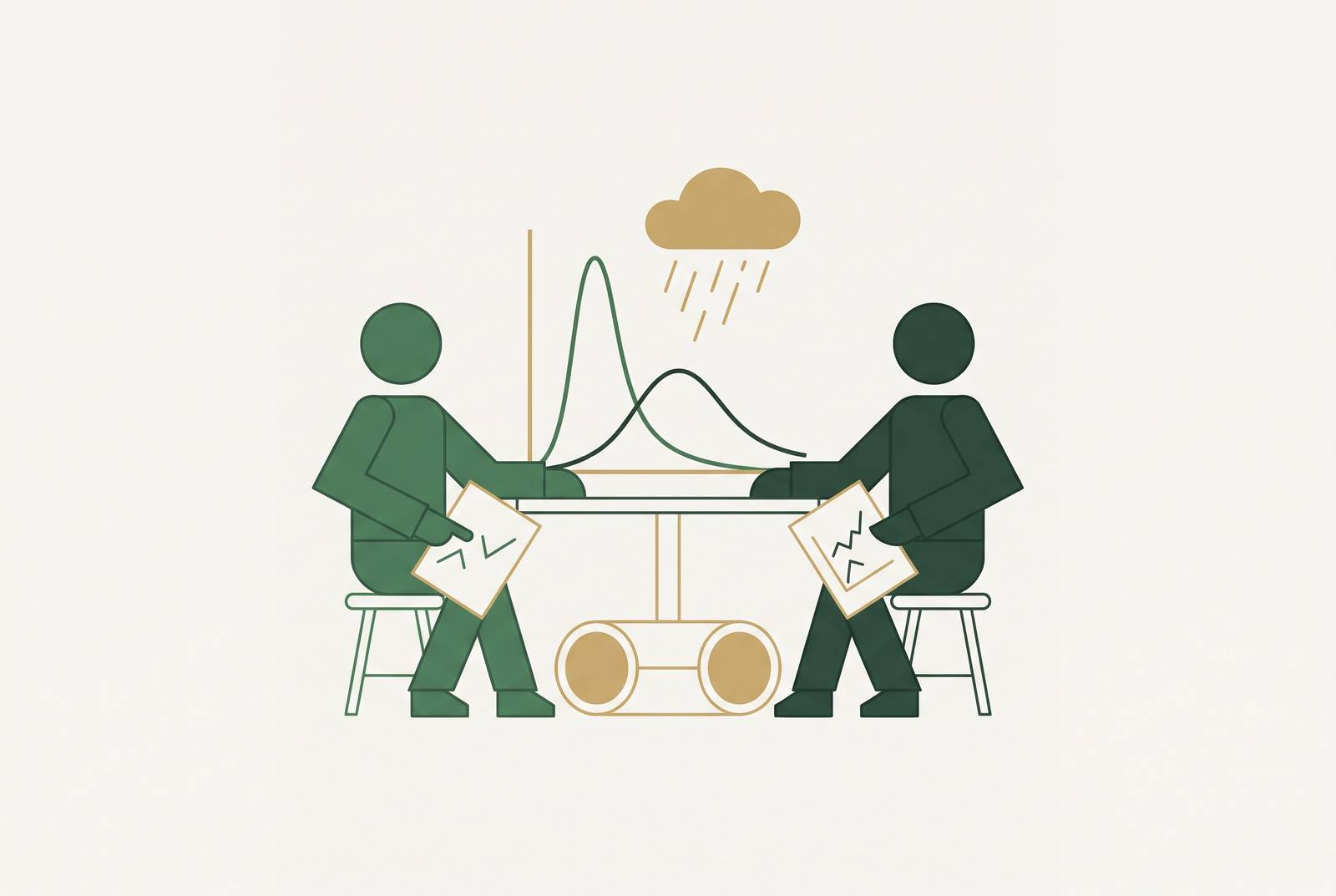
Applicants and agency reviewers disagree over hydrology methods because they need an answer they can defend when making regulatory decisions, but no single binding standard tells them which hydrologic method is correct. Resolving these disputes therefore depends on distinguishing errors from legitimate differences in method selection, parameter assumptions, and data interpretation. That distinction is the foundation for reducing unnecessary redesign, protecting project schedules, and framing challenges that formal review processes can resolve.
Why hydrology methodology disputes are structurally unavoidable
FEMA’s guidance acknowledges that “there is room for disagreements as to what constitutes standard engineering practice” and explicitly distinguishes the applicant’s engineer, who works for the permit applicant, from the reviewing community. The registered professional engineer prepares the analysis in the applicant’s interest, while the agency decides whether to accept, modify, or reject it. Their judgments need not converge.
The Rational Method, Modified Rational Method, SCS TR-55/TR-20, HEC-HMS with multiple loss methods, continuous simulation models, and hydrodynamic 2D models can all be acceptable, with acknowledged trade-offs. Acceptance of several methods does not establish which is appropriate for every application. Consequently, both sides can cite legitimate engineering precedent for incompatible choices without either acting in bad faith.
How curve number selection becomes a recurring flashpoint
The SCS-CN method turns this broad discretion into specific parameter choices. Choosing a curve number takes professional judgment, and some parameters have more than one value that an engineer can defend. The ASCE EWRI CN-Hydrology Committee “often finds itself internally at odds regarding many aspects of CN-hydrology.” When recognized experts differ over the method’s foundations, an applicant and reviewer cannot always settle their differences simply by appealing to accepted practice.
The method’s evolution helps explain that uncertainty. Since its mid-20th-century creation, this empirical model has been applied across many hydrological applications, while the rationales for its parameters have become removed from physical interpretation. The initial abstraction ratio, Ia/S, is one point on which disagreement has been documented. Land use classifications that stay fixed and empirical assumptions limit how accurate the method can be across different regions and complex hydrological scenarios. These objections have a scientific basis beyond competing preferences about conservatism.
Antecedent runoff condition classification gives those objections a direct permitting consequence. Engineers may select ARC I for dry conditions, II for average conditions, or III for wet conditions, with CN adjustments reflecting soil moisture, canopy cover density, vegetation growth, and temperature. Applying the ARC factor is optional and depends on professional judgment. The choice can determine compliance. An applicant using ARC II where a reviewer expects ARC II/III will calculate materially lower peak flows, potentially separating a passing detention design from a failing one.
How time of concentration assumptions shift computed peak flows
Time of concentration creates a similar dispute through a different parameter. Tc is the time water takes to travel from the hydrologically most distant point in a watershed to its outlet, and peak flow estimation depends on it. Applicants routinely lengthen Tc to reduce computed peak discharge, while reviewers favor shorter, more conservative values. The incentives point in opposite directions. A disagreement about the selected travel pathway therefore becomes a disagreement about the discharge the design must accommodate.
New Jersey’s 2026 stormwater manual addressed this parameter directly. The state declared that “there is no longer a minimum or default value that may be used for the time of concentration,” removing a floor provision applicants had used to bound calculations. That change removes a previously available basis for selecting a value. It also expands the range of technically defensible values an applicant may submit, converting a bounded disagreement into a more open-ended one. The change shows that the state is addressing how Tc is chosen, though the choice still takes professional judgment.
How model selection and encroachment method disputes play out in FEMA appeals
Disputes over which model or encroachment method to use go beyond the values entered into an accepted model. FEMA’s Scientific Resolution Panel provides an avenue for unresolved technical disagreements involving hydrology, hydraulics, and geospatial data when conflicting technical or scientific data emerge during the statutory 90-day appeal period. The grounds for challenge are specific. Under 44 CFR Section 67.6(b)(2), a methodology may be technically incorrect because of errors in application, inferior data, or incorrect application based on insufficient or poor-quality data. A formal appeal therefore requires more than a preference for another approach.
In a documented split-flow dispute, appellants argued that FEMA’s analysis incorrectly modeled a split-flow floodplain and consequently underestimated flows in the main channel. In a separate methodology dispute, a city contended that “FEMA’s 2009 hydrologic methodology produces results that are less accurate to those developed by flow transposition.” These are challenges to the analytical foundation itself. Their consequences extend to mapped flood hazard, rather than only to the design of an individual stormwater facility.
What happens when an agency switches modeling paradigms mid-stream
When an agency changes the method it uses, it can change what everyone it regulates must do. The Idaho Department of Water Resources made such a change for the Eastern Snake Plain Aquifer in its revised Sixth Methodology Order, switching from “steady state” to “transient” model simulations to determine curtailment dates. Steady state modeling assumes the aquifer is in quasi-equilibrium and that Snake River reach gains increase over time from continuous curtailment. Transient modeling looks at reach gains from short-term curtailment within a given irrigation season.
Before the switch, ground water users with rights senior to 1977 were never on the curtailment list, even when predicted in-season demand shortfall was large. In one 2023 curtailment cycle after the switch, all ESPA ground water users became susceptible, including those with 1901 rights, even when the predicted shortfall was less than 100,000 acre-feet.
IDWR’s explanation framed the change as a legal and operational necessity. Its FAQ stated that steady state modeling was “no longer legally supportable because steady state does not provide water at the time, place, and quantity needed by the senior water user.” A&B Irrigation District had endorsed the methodological switch but subsequently found itself adversely positioned by it. The Director affirmed dismissal of A&B’s challenge on res judicata grounds on April 17, 2026, illustrating how procedural limits can become decisive after a methodology takes effect.
How peer review can overturn a methodology the agency accepted
Independent review can challenge assumptions that regulatory review did not raise, exposing an applicant to a separate line of scrutiny. In September 2026, Dr. Younes Alila, P.Eng., reviewed WaterSmith’s 2025 Hydrologic Risk Assessment for watersheds draining northward from Mount Rose Swanson. He concluded that it was “scientifically indefensible” because its methodology was outdated and peer-reviewed literature showed that it underestimated forests’ ability to reduce risks to peakflows and low-flows. His conclusion remained unchanged after WaterSmith responded in October 2026.
The distinction between acceptance and scientific endorsement is consequential. An independent reviewer can challenge the basis of a consultant’s analysis even after it passes agency review, because that acceptance offers no protection under the review process. That does not make peer review an exceptional adversarial intervention. Agencies also use it to test their own methods before making a final decision.
The Northwest Florida Water Management District chose to have its draft minimum flow technical assessment for Jackson Blue Spring undergo independent scientific peer review, which was completed in January 2026. Reviewers evaluated whether the data were best available, assumptions were clear and reasonable, procedures were appropriate, and methods were scientifically reasonable. Oregon DEQ similarly convened a scientific panel for its updated freshwater biocriteria assessment methodology for the 2026 Integrated Report before public comment. Both processes institutionalize scrutiny of methodological choices.
Why climate data is becoming the newest source of methodology disputes
Climate-adjusted precipitation data adds another unresolved choice to hydrologic analysis. Applicants and agencies increasingly face expectations to incorporate it, but no binding standard specifies which dataset or scenario applies to a given project. FEMA has declined to codify the specific climate scenarios used in its CISA analysis. That leaves choices about both the underlying data and the application of annual-chance floodplain thresholds or a climate-informed scenario. Scientific relevance and procedural acceptability can therefore diverge.
A 2026 Whatcom County, Washington permit proceeding made that divergence concrete. An examiner allowed the City of Blaine to keep using a 77-year-old rain dataset for stormwater modeling and ruled out more recent climate science under the rules for exhibit lists. The older data predated the frequent atmospheric rivers now flooding the county almost yearly. The outcome turned on procedure. It illustrates how applicants can defend established datasets in the absence of a binding replacement requirement, while reviewers can question whether those datasets reflect physical conditions.
Agency uncertainty can also affect who must prepare an analysis. Washington State’s 2026 guidance threatened to complicate water-right change applications by abruptly requiring a licensed geologist in addition to the engineer already retained for well impairment analysis. The agency withdrew the directive under pressure. Nevertheless, it illustrates the related problem of agencies introducing methodological requirements without established standards to anchor them.
What the costs of unresolved methodology disputes look like in practice
Unresolved disagreements impose costs through both redesign and delay. In stormwater review, concessions requested without a technical basis can accumulate into a system that is larger, more expensive, and more land-consumptive than regulations require. A request for deeper bioretention, for example, may increase the design burden without identifying a failure to meet the numeric standard. Bad faith is not a necessary explanation. Substituting reviewer preference for an engineering judgment that already satisfies the requirement creates a structural problem.
The Idaho case shows the same stakes at a different scale. Its modeling switch expanded potential curtailment from a subset of users to every ESPA ground water user, including holders of century-old senior rights. The resulting exposure was not confined to one applicant. Method selection can redistribute obligations across a regulated population, making the cost of disagreement far greater than the expense of rerunning a model.
Strategies for reducing and resolving methodology disputes before they escalate
Applicants and their engineers should respond to this structural uncertainty by narrowing disagreements before they become embedded in a completed analysis. Pre-submittal engagement on method selection allows questions about ARC classification, Tc assumptions, and encroachment methods to be addressed before a stamped submittal. Agreement early on leaves less to challenge later. It does not require treating every reviewer preference as a regulatory obligation.
Explaining why ARC II was selected rather than III, why a particular Tc pathway was used, and which dataset underlies CN values gives the reviewer a specific basis to evaluate. A challenge must then address that reasoning. Where a design meets the numeric standard, distinguishing requirements from preferences allows applicants to concede what regulations demand while defending the engineering judgment used to select the treatment train.
Formal review mechanisms require equally precise framing. Applicants using the SRP process should connect a challenge or defense to errors in application, inferior data, or misapplication of a method within the applicable appeal framework. Proactive independent peer review can also test a methodology before submittal. For climate data, documenting the selected dataset and why it represents current best available information should be paired with attention to the procedural grounds on which newer evidence could be excluded.
AI-assisted engineering tools can help licensed engineers do this work by comparing results from different methods, including SCS-CN results against HEC-HMS runs or alternative Tc pathways. Such comparisons provide a documented basis for selection rather than leaving a single scenario vulnerable to an untested alternative. Licensed engineers must review and approve all outputs before they are submitted.