Resubmittal Strategy After Multiple Rounds of Stormwater Review Comments
A comment matrix, cover letter, and reviewer call can end repeat rounds.

Stormwater resubmittals after multiple review rounds require more than corrected calculations. They need a response package that clearly shows how each comment was resolved. A structured matrix, a reviewer-focused cover letter, and coordination before submission give engineers a clearer path to approval while limiting the fees, lost hours, and schedule delays that accumulate with each additional round.
Why stormwater reviews stall in third and fourth rounds
A third-round comment letter arrives, and the team cannot explain why the same issue is still open. The calculation was revised, the plan changed, and a response submitted. Yet the reviewer still lacks a clear connection between the original concern and the evidence needed to close it. Reviewers check one comment at a time, so work that is done can look unfinished if the response leaves out what changed and where.
New comments in later rounds can reflect the same failure of framing. Undisclosed changes also expand what the reviewer must examine. San Antonio’s stormwater review checklist requires a cover letter response to each set of comments and separate resubmittal packages for concurrent reviews. The checklist also requires certification that plans contain no changes beyond those addressing comments, or a description of any other changes.
What escalating fees and schedule slippage actually cost when rounds compound
Kansas City charges extra percentage-based fees on third and later reviews, including a site disturbance fee and a public infrastructure fee based on the total approved infrastructure valuation. The larger the project, the more those fees can cost. Internal costs accumulate at the same time. Each round requires response letters, exhibit updates, calculation narrative revisions, and coordination that typically go unrecovered under fixed-fee contracts. For small and mid-size firms, a third round can turn a job that would make a profit into break-even work.
DuPage County Stormwater Management targets 20 working days per standard resubmittal round. Each added round means another wait for review, which affects more than the engineering contract. Permit delays can push back construction starts, delay mobilization, leave the owner paying carrying costs for longer, and make it harder for contractors to keep to their schedules. A comment-by-comment closure check gives the team a way to identify unresolved issues while it can still discuss them and avoid paying for another cycle.
Building the comment-tracking matrix that prevents comments from carrying forward
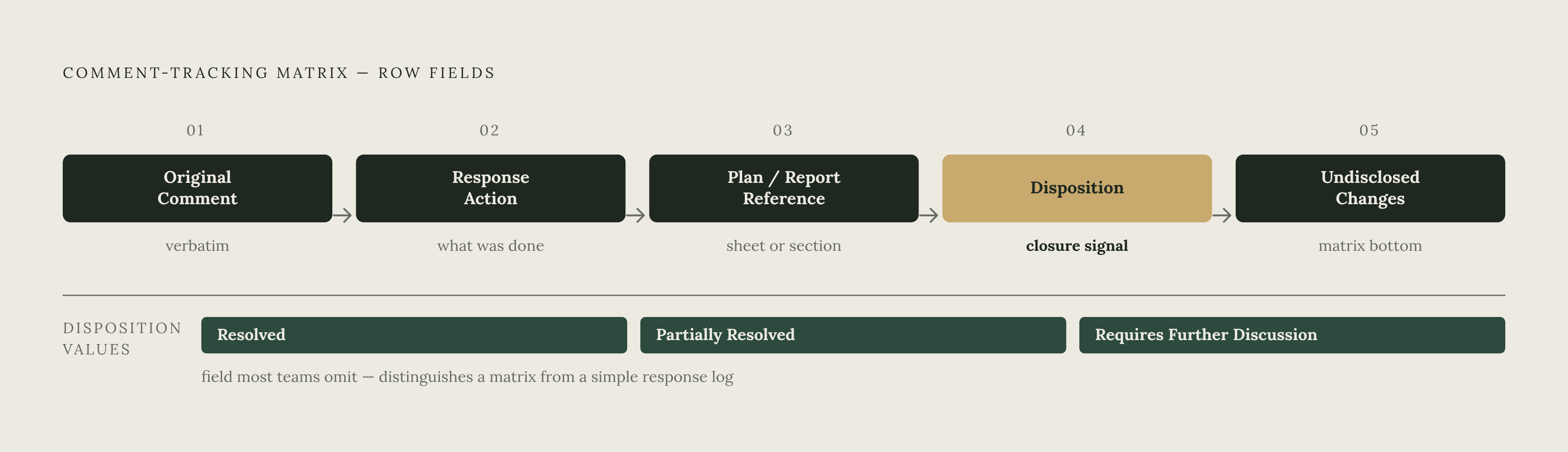
The foundational document is a matrix with one row for every reviewer comment. Each row should contain the original comment verbatim, the response action taken, the plan sheet or report section where the change appears, and a disposition. The dispositions should distinguish resolved, partially resolved, and requires further discussion. Use the reviewer’s numbering throughout the document. An internal numbering system makes the reviewer translate between records when the purpose of the matrix is to eliminate that work.
The location field must identify every affected sheet and calculation section. If a comment changes several parts of the package, its row should connect them. A partially resolved disposition is useful information. It shows that the engineer recognizes the remaining issue. Items requiring discussion can then become the agenda for coordination before submission, while resolved items have a documented action and a complete set of cross-references.
Changes unrelated to comments need their own section at the bottom of the matrix to make the disclosure required by the checklist visible. Keep each round’s matrix as a version-controlled document. By round three, the reviewer should be able to trace rounds one and two together with the current response in a single reference. That history helps distinguish a newly introduced change from an issue that has remained unresolved through successive responses.
Writing the cover letter that gives reviewers a clear path to approval
The cover letter deserves the same attention as the matrix because it establishes how the reviewer will approach the package. The opening should give the round number, the date of the preceding comment letter, and the total number of comments being addressed. Those details orient a reviewer handling many projects. The matrix can then supply the item-level evidence without having to establish the submission’s context in every row.
For each substantive comment group, including hydrology, detention, grading, and water quality, provide a paragraph-length explanation of what changed. The explanation should give the reviewer a mental model before they open the plans and calculations. It need not duplicate every matrix entry. Instead, it should explain the relationship among revisions that answer the same underlying concern. A letter organized around the reviewer’s concerns is more useful than one organized around the order in which the design team completed its work.
A disagreement or alternative approach belongs in the cover letter, where the reviewer can evaluate the technical argument before encountering it in a response cell. State the reasoning plainly. Unresolved questions also need an explicit place. Close by identifying items that require a conversation and proposing a meeting. The letter then frames both the evidence submitted for closure and the issues that still need a shared interpretation.
Pre-resubmittal coordination with the reviewer and when to request a meeting
After round two, requesting a brief reviewer meeting is one of the highest-leverage interventions available to the engineer of record. Most engineers skip this step, but skipping it is a mistake. Comments often keep coming back because written exchanges have not made clear what the reviewer expects. Most jurisdictions accommodate coordination with reviewers. DuPage County explicitly recommends free pre-application coordination meetings, and the same reasoning supports a discussion before resubmitting after a contentious round, without assuming the two meeting processes are identical.
A 30-minute call before round three can check whether the engineer has understood the disputed comments, bring out expectations that went unstated, and show that the engineer has prepared. Send a one-page agenda identifying the specific comments to discuss. Keep the discussion anchored to those unresolved items. When a comment has survived two rounds of written responses, another revised paragraph may not reveal what the reviewer actually needs to see. A direct exchange can expose that gap before the team commits to another package.
For concurrent stormwater, drainage, and floodplain reviews, include all relevant review staff in the meeting where possible. Separate packages do not require separate conversations. The checklist still requires separate packages, but a joint discussion can cover questions that span more than one review. Follow the meeting with a brief email summarizing what was agreed. That record protects both parties and reduces interpretation drift between the conversation, the revised documents, and the next review.
Stormwater-specific technical issues that generate repeat comments and how to close them cleanly
The reviewer’s technical checklist should shape the evidence attached to each response. The San Antonio checklist is a detailed model, though its requirements may differ from those in other jurisdictions. Detention comments often ask for routing documentation rather than another statement of final storage volume. The checklist’s general routing submittal requirements identify Modified Puls or Muskingum-Cunge routing with reach lengths and velocities, so those requirements should not be described as applying exclusively to detention basin documentation.
For impervious-cover responses, the written analysis and the exhibit must agree. The checklist calls for existing and proposed conditions with detailed percentage calculations. When the calculation changes, update the corresponding exhibit and identify both locations in the matrix. The reviewer can then examine the percentages and the depicted conditions together rather than return a comment about a discrepancy between them.
Grading and conveyance comments require similar attention beyond the main drainage path. Reviewers check T-intersections, cul-de-sacs, and knuckles for contained runoff, and the checklist requires interceptor channels when offsite drainage exceeds specified thresholds. A revised main conveyance route does not answer an unresolved intersection-grading concern. The response must clearly show which locations are affected.
How AI tools can accelerate comment-response documentation without replacing engineer judgment
AI can shorten the documentation work behind the matrix and cover letter, but it does not replace either document. Drafting comment responses, writing calculation narratives, and cross-referencing exhibits follow patterns but take a great deal of time. Generative tools can produce alternative narratives or calculation summaries based on performance criteria. Those alternatives remain drafts for engineering review. Their value is in giving the team time to consider clearer framing rather than submitting the first workable explanation under schedule pressure.
Autodesk InfoDrainage’s Machine Learning Deluge Tool supports a different part of the response process by generating responsive flood maps without rerunning complex computational simulations. It provides live feedback on water channeling and ponding during revisions as well as initial design. That capability supports examination of a changed design. Civil 3D 2026.2 also expands Dynamo nodes for stormwater control workflows, enabling automation of drainage design and analysis tasks. These functions can support comment resolution without substituting for the technical explanation a reviewer needs.
The Autodesk Assistant’s planned ability to analyze active models, highlight specification violations, and suggest design fixes remains a future agentic capability in development. It should not be presented as available functionality. AI-assisted takeoff tools offer another form of support. They have achieved high accuracy in quantity counts on clean, vector-based drawings, but accuracy varies significantly with drawing quality and project type. Their usefulness in reconciling revised quantity exhibits therefore depends on the material being reviewed.
The accountability boundary is non-negotiable. AI writes draft documentation, and a licensed engineer must review, correct, and stamp everything it produces. Automation does not transfer professional responsibility or provide the legal standing of an engineering submission. Time saved on documentation should support the work that requires judgment, including the argument for a contested comment, detention routing verification, and the reviewer conversation before submission. The tool accelerates preparation while the engineer remains responsible for the package.
What small and mid-size civil firms can do now to reduce resubmittal rounds structurally
Small and mid-size firms can put these practices in place without building a large internal program. A principal can adopt a standard today and apply it to the next submission. The first change is a firm-standard response matrix used from round one, before documentation debt accumulates. Name one person on every project to be in charge of comment tracking. That role may belong to the engineer of record or project engineer, but it should not depend on an assumption that someone else is maintaining the record.
The next step is a pre-resubmittal checklist that mirrors the jurisdiction’s review criteria. The checklist and DuPage County’s submittal flow charts provide public models that firms can adapt for internal quality control. Keep a jurisdiction-specific notes file as well. Reviewer names, what they are known to prefer, common comment patterns, and informal standards missing from the written criteria can help teams on later projects. This lets the whole firm see what reviewers expect, instead of keeping that knowledge within one project team.
For resubmittal support, the useful question is whether a tool fits the firm’s existing Civil 3D, Revit, and documentation work. Adoption friction can keep a useful capability confined to pilots. With a workflow the team knows, it can judge whether automation cuts the time spent preparing responses. The response standard must remain intact regardless of which tools support it.
In 2025, California’s State Water Resources Control Board adopted requirements for reporting costs in a standard way for MS4 permits. The Federal 2021 MSGP expired in February 2026 and is being administratively continued while EPA’s proposed 2026 replacement remains pending finalization. These developments form part of a more demanding stormwater compliance environment. Firms cannot control every review requirement or change from one permit to the next.
They can control how deliberately they prepare each response. Consistently resolving reviews in one or two rounds is not necessarily evidence of superior engineering to teams cycling through four. It can come from better tracking, clearer documentation, and talking with reviewers earlier. Those are learnable practices. With named ownership and a repeatable response standard, the team already in place can make review closure a firm capability.