SWMM LID Module for Green Infrastructure Modeling
SWMM's layered LID framework earns trust only when understood.

SWMM’s LID module models how green infrastructure captures, stores, infiltrates, and routes stormwater through a physically based layer framework. Its usefulness for design depends on understanding that architecture. A model becomes trustworthy not simply because it produces a hydrograph, but because its control types, layer parameters, routing, and calibration represent the processes the design depends on.
Why green infrastructure modeling needs a physically grounded framework
The ASCE EWRI webinar series describes low impact development and green infrastructure as becoming the national standard of practice for urban stormwater management. These practices modify runoff through infiltration, soil storage, evapotranspiration, and slow drainage. A simple rational-method or curve-number approach cannot account for those processes across layers. A framework that omits them can mislead sizing, placement, and performance expectations even when its outputs appear plausible.
The EPA Storm Water Management Model, or SWMM, provides dynamic rainfall-runoff simulation for stormwater planning, analysis, and design, with green infrastructure represented through its LID module. That capability raises the central engineering question. What does the module actually do, and how does its architecture affect a model’s trustworthiness?
How SWMM fits green infrastructure into its broader simulation engine
SWMM divides a study area into subcatchments with pervious and impervious sub-areas. LID controls belong within each subcatchment’s hydrologic budget, as do aquifers and snow packs, rather than operating as calculations appended to the model. This integration links local capture and drainage to the broader runoff simulation. The downstream consequences remain part of the same model. SWMM also accounts for groundwater interflow, pollutant buildup and wash-off, and water quality constituents, allowing runoff volume, peak flow, and pollutant loads to be evaluated together.
Single-event simulation shows what happens during one storm, while long-term continuous simulation shows the effects of antecedent moisture and the annual volume reduction. Both serve distinct design questions. Since explicit LID modeling was added to SWMM 5, routing has been expanded so that drains can discharge somewhere other than the parent subcatchment’s outlet and controls can receive pervious as well as impervious runoff. These options make the representation of connected green infrastructure more explicit.
The eight LID control types SWMM defines and what distinguishes them
The SWMM 5.2 User’s Manual defines eight generic control types as distinct physical archetypes, namely bioretention cells, rain gardens, green roofs, infiltration trenches, permeable pavement, rain barrels and cisterns, rooftop disconnection, and vegetative swales. Each activates a particular arrangement of layers and processes. Selecting a type therefore determines what the model can represent before any parameter values are entered.
The distinctions follow the water’s available paths. A green roof has no infiltration into native ground, while a bioretention cell represents that pathway. A rain barrel stores water but does not infiltrate or evapotranspire it as a vegetative swale does. The control type constrains the governing parameters. Using one type as a proxy for another practice can therefore change both the simulated mechanisms and the terminology attached to the result.
The vertical layer architecture that makes each LID control a physical model
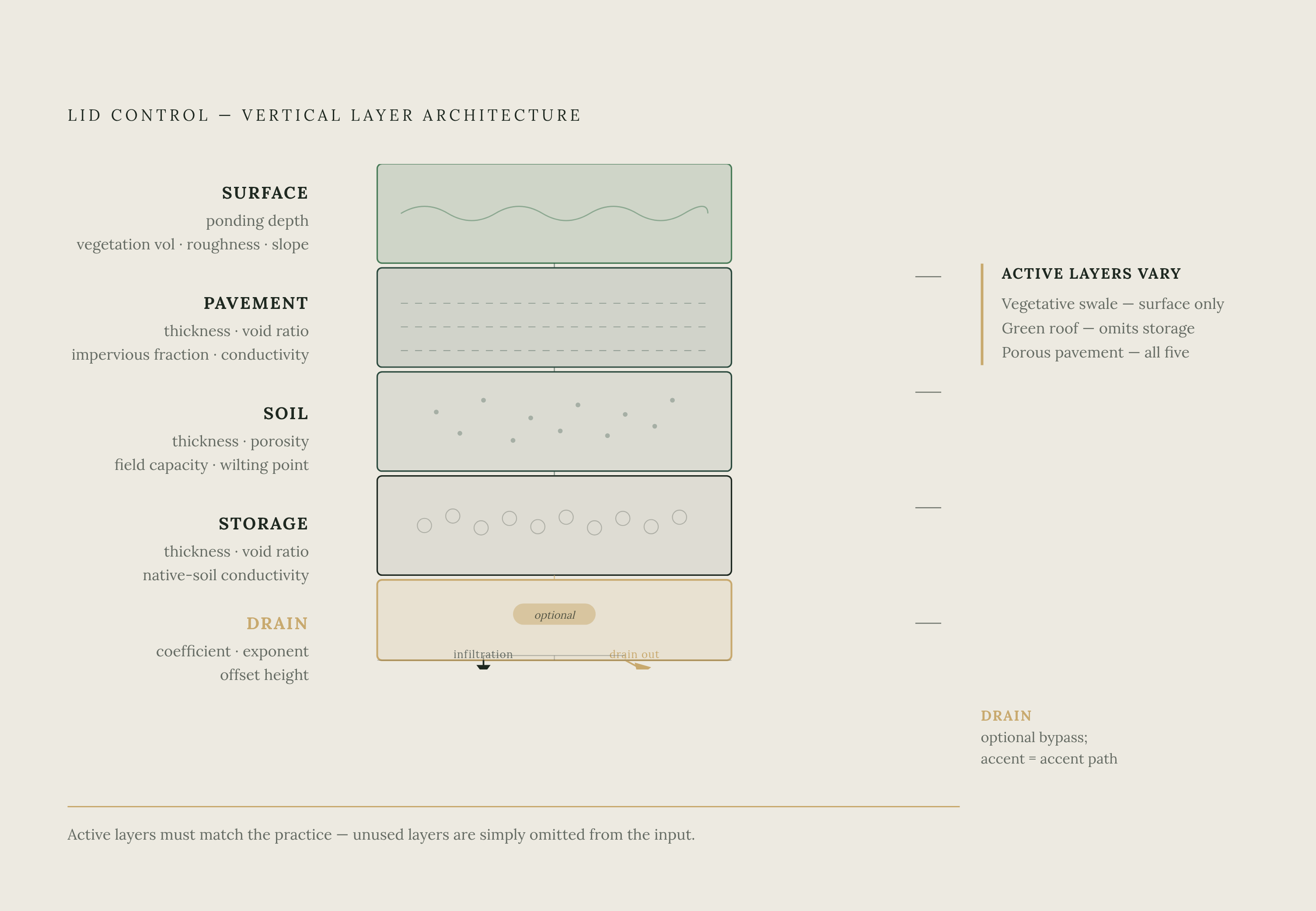
The manual describes a stack of up to five principal layers, which are Surface, Pavement, Soil, Storage, and Drain. Water enters at the surface, where ponding depth, vegetation volume, roughness, and slope govern capture and overland outflow. Surface storage is the first physical constraint. In permeable pavement, the pavement layer then controls passage through the paving material using its thickness, void ratio, impervious fraction, and hydraulic conductivity.
The soil layer represents the growing medium or soil through thickness, porosity, field capacity, wilting point, and conductivity parameters. These distinguish water storage from water movement. Beneath it, the storage layer stands for a gravel reservoir or cistern, whose thickness and void ratio set how much water it can hold, while native-soil conductivity controls infiltration below it. An optional underdrain provides another exit. Its coefficient, exponent, and offset height govern when and how quickly water exits through the underdrain.
Not every control uses the whole stack. A green roof uses a growing medium and drainage mat without storage that infiltrates into native ground, while a vegetative swale has no subsurface layers. The active layers must match the practice. Their parameters can come from soil tests, material specifications, or published defaults because they describe physical properties rather than coefficients chosen just to fit the results. Setting field capacity equal to porosity, for example, erases a distinction within soil storage and changes the accounting on which downstream results depend.
How subcatchment-scale deployment and routing decisions shape model results
A correctly configured unit can still sit inside a poorly configured watershed model. SWMM deploys controls as replicate units within a subcatchment, with specified areas and runoff contributions. Total LID area and coverage determine how much runoff is intercepted before reaching the drainage system. Routing is equally consequential at this scale. Allowing a drain to discharge to another node or subcatchment supports explicit cascades, such as a green roof draining to a bioretention cell.
The ASCE EWRI webinar series, Modeling LID and Green Infrastructure Using SWMM, illustrates this distinction through a greenfield development in Parker, Colorado. Because the setting is mostly residential, it raises different questions about deployment and disconnection than a dense redevelopment would. The series also examines an ultra-urban project on the South Platte riverfront in downtown Denver. The contrast shows why subcatchment representation, particularly impervious area disconnection, must reflect the setting.
What SWMM's LID module can and cannot do with soil physics
SWMM’s LID module relies on field capacity and does not simulate unsaturated flow or account for soil water potential. This simplification can produce runoff overestimation or underestimation where moisture dynamics control performance. A documented comparison found underestimated peak infiltration rates and infiltration calculations beginning only after moisture exceeded field capacity. This misses the pulse of infiltration early in a storm when soils are partially saturated.
Green roofs introduce a further interpretive limit. Calibrated hydraulic conductance and drainage variables should not automatically be read as descriptions of actual physical processes. The documented inconsistency concerns hydraulic head logic relative to the bioretention control, while roof drains also cannot be modeled as orifices and weirs as non-LID elements can. These limitations affect ordinary design conditions, including partial saturation and moderate rainfall. Given these limits, LID results can help compare scenarios and guide order-of-magnitude sizing, but fitted soil parameters still need to be checked against field measurements.
Why calibration is the most consequential — and most contested — step in SWMM LID modeling
Calibration must bring these simplified processes into line with what is observed. Manual trial and error remains a common approach, but it is slow, subjective, and vulnerable to finding a good fit for the wrong physical reasons. Multiple parameter combinations can produce similar hydrographs. A close match alone cannot identify which combination represents the site defensibly.
That problem affects hydrologic models in general, but it is harder to deal with in SWMM because LID layer parameters interact and there is no universal internal tool for adjusting them. Automated optimization can accelerate calibration and reduce errors without eliminating uncertainty from sparse flow records or complex urban configurations. Bayesian optimization-integrated approaches have been developed to address part of that efficiency and subjectivity problem.
The Istanbul Ayamama watershed study used PEST to calibrate a model containing green roofs, permeable pavements, and bioretention cells. That coupling supplied optimization outside SWMM’s native tools. A campus study in China coupled a Back Propagation neural network to parameter calibration and NSGA-III to facility layout optimization. Outside methods play a growing role in calibration and the search for designs, but engineers still have to judge what the results mean physically.
How SWMM results vary by LID type, combination, and storm scenario
In scenarios that used each practice on its own, permeable paving reduced total runoff more than green roofs and sunken green space across 5-, 10-, and 20-year events. Other results showed that bioretention cells reduced the pollution load the most. Those findings answer different performance questions. They do not establish a universal ranking of practices.
The 2021 Istanbul analysis found that green roofs used with permeable pavement reduced peak flood and runoff volume the most in its highly urbanized watershed. The largest drop in runoff was 56.02% for a 10-year storm. The 2025 Taoyuan Water Recycling Center study in Taiwan found that total runoff and peak flow fell even during long periods of rainfall because the practices covered a large area and included a mix of types. Schmelzing and Schmalz’s 2025 Frankfurt study found that when enough of the available impervious area was treated, effectiveness rose as the implementation percentage rose and fell as building density rose. In that study, building density had a greater adverse effect than climate change, illustrating why site configuration cannot be replaced by a generic performance ratio.
How climate projections change what SWMM LID models need to test
EPA has a software tool for using future climate projections in SWMM modeling. Designs need to be checked for how well they work under projected rainfall as well as under a current storm assumption. Historical compliance does not settle that question. Climate-adjusted inputs provide a way to expose a performance gap before construction commits the design.
The Frankfurt study tested both the high emission scenario RCP 8.5 and the climate protection scenario RCP 2.6 across different building densities. Its results distinguished performance trajectories associated with those combinations. Other analyses have shown that performance could fall as future water volumes rise, including a scenario-specific change of up to 100% in green roof infiltration performance from historical baselines. The value of climate stress-testing lies in evaluating the interaction between projected rainfall and the actual coverage, storage, and drainage represented in the model.
How machine learning surrogates are changing the computational economics of SWMM LID optimization
Running physical simulations over and over becomes costly when optimization tests many facility types, coverage levels, and layouts. Machine learning surrogates address that burden by learning from SWMM outputs and replacing repeated engine runs within the search. One framework that paired a surrogate with a genetic algorithm cut computing time by roughly two orders of magnitude compared with conventional EPA-SWMM runs while searching for LID combinations for each land use.
A deep neural network coupled with an enhanced-mutation NSGA-II algorithm, DNN-DM-NSGA-II, optimizes construction costs, runoff volume, and pollutant load. Yun and Kang’s December 2025 study in Seoul used a SWMM-based LSTM model to predict runoff for a full year of rainfall in seconds, compared with nearly two hours for conventional simulation. Speed does not create independent physical authority. The surrogate learns the behavior represented in its training runs, so errors in layer parameters or routing propagate into the accelerated workflow.
What engineers need to get right before trusting a SWMM LID result
Engineers should start with soil test data, material specifications, and published EPA or NRCS guidance rather than rely on calibration to give the parameters physical meaning. They also need to identify active layers, sensitive parameters, and the decisions affected by simplified soil physics. Calibration then tests a defensible representation against observations. It should not turn an implausible representation into an apparently authoritative one.
For performance evaluation, continuous simulation is preferable because antecedent moisture, seasonal evapotranspiration, and storm sequences drive annual volume reduction. Sizing must also remain site-specific, since no universal drainage-area-to-LID-area ratio resolves local conditions. Where extensive optimization is required, surrogate workflows offer a credible way to expand the scenarios evaluated. Their outputs require the same physical scrutiny as direct SWMM runs. Licensed engineers remain accountable for reviewing results against physical intuition and stamping only what they can defend through an understanding of what the model does and does not resolve.
Sources
- Evaluating the stormwater runoff reduction effect of green infrastructure using a SWMM-based LSTM model: A case study of Seocho-gu, Seoul - ScienceDirect
- Storm Water Management Model (SWMM)
- Modeling Low Impact Development and Green Infrastructure Using the EPA Stormwater Management Model: SWMM Basics (AWO101920)
- Simulating Effectiveness of Low Impact Development (LID) for Different Building Densities in the Face of Climate Change Using a Hydrologic-Hydraulic Model (SWMM5)
- Modeling Low Impact Development and Green Infrastructure Using the EPA Stormwater Management Model: SWMM Basics
- Hydrologic performance assessment of low impact development facilities based on monitoring data and SWMM modeling in an urban catchment in Taiwan