Training AI on Firm-Specific Standards and Past Drainage Projects
Firm-trained AI starts from your accepted methods while engineers keep final judgment.
Training AI on a firm’s drainage standards and past projects gives it a starting point that a generic model lacks. The purpose is to produce work that already reflects the firm’s accepted methods, documentation and design preferences. Done well, this shortens production without removing the licensed engineer’s judgment from the process.
Why drainage design is unusually well-suited to firm-specific AI training
Drainage design requires several constraints to be satisfied together, including positive drainage away from structures, ADA slope compliance, earthwork balance and stormwater detention volumes. These constraints interact differently on every site. A grading decision that addresses one requirement can change what is needed elsewhere, so manual design proceeds through iterative trial-and-error. A generic AI model lacks the firm-specific knowledge needed to narrow that iteration. It can address drainage principles without knowing which solutions fit the firm’s working methods or the reviewing agency’s expectations.
That distinction makes firm-specific training a functional requirement. A firm’s preferred detention sizing approach, the runoff methods a local agency accepts and the sequence of grading relative to utilities all shape a usable design. These decisions record how the firm has resolved recurring problems under actual project constraints. The archive of past project files, calculation packages and internal standards holds the judgment built up over time that a generic model cannot reproduce.
What "training on firm data" actually means in a drainage context
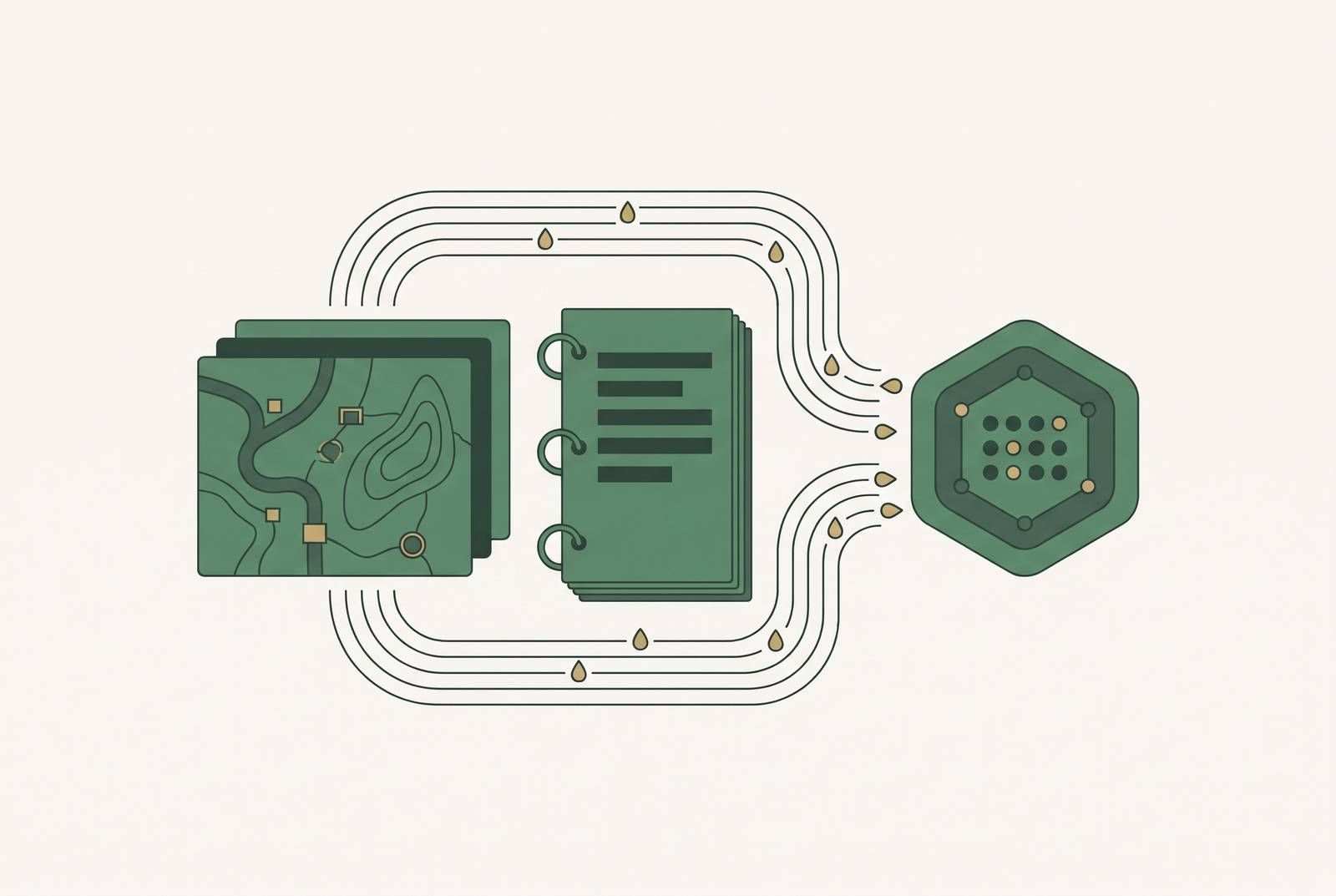
Training on firm data means learning the firm’s design decisions along with the engineering principles behind them. The training corpus includes completed drainage calculation packages, grading plans, hydraulic analysis reports, hydrology studies, agency-accepted submittals and internal QC checklists. Each contributes a different part of the design record. Together, they show which detention pond geometry the firm uses on constrained sites, how it documents HEC-RAS inputs for a particular county reviewer and which slope tolerances it applies in ADA-sensitive areas. Those patterns give the AI a basis for producing work in the firm’s established form.
Local AI systems running within company infrastructure support custom model training on these datasets while keeping project data inside the firm’s environment. This is distinct from adding a shared platform capability. Civil 3D 2026.2 adds workflows for ponds, underground storage, open channels and expanded catchment delineation. It also adds a large set of Dynamo nodes for stormwater control objects, with Autodesk AI-assisted node suggestions in Dynamo Core v3.6.1. These capabilities provide useful production tools available to every firm using the platform.
Firm-specific training adds the decisions that the platform alone does not contain. Mellite’s enterprise training model identifies firm-specific technical archive integration, including training agents on internal project archives, as a distinct capability. The distinction is between what a tool can do and how a particular firm expects that work to be done.
How the AI uses that training when it starts a new drainage project
On a new drainage project, the trained AI begins with established answers to recurring problems. Past submittals supply precedents for the agency’s preferred runoff method, the firm’s standard pond sizing approach and the documentation format that previously cleared review. Those choices shape the first proposed output. Instead of building a drainage network from scratch and then adjusting it to match familiar requirements, the AI proposes one informed by the firm’s earlier resolutions.
The same holds when grading optimization balances drainage slope, ADA compliance, earthwork and detention together. The system learns the firm’s past earthwork tolerances and preferred grading sequences, so they no longer have to be entered as parameters for every job. This reduces repeated setup and early-stage adjustment. It does not establish that a past solution is appropriate for a new site, because the new combination of constraints still requires engineering judgment.
The archive also supports work that precedes production. A searchable AI-indexed record reduces the time engineers spend hunting through old folders for a comparable project. That benefit extends to preparing deliverables such as drainage calculation packages and hydraulic analysis reports, where accepted precedents help establish the expected documentation. The practical compression comes from less searching, less repeated setup and fewer corrections to generic assumptions, rather than from treating engineering review as expendable.
Why data privacy is a prerequisite before training begins
A drainage archive contains client site data, agency-specific decisions, proprietary calculation methods and accepted submittals that represent the firm’s competitive knowledge. When the firm hands that archive to an AI system, it has good reason to ask who owns and controls it. Privacy must be established before training begins. The required architecture keeps each firm’s data private and prevents it from being used to train models that serve other firms.
Local systems running within company infrastructure can meet that requirement by keeping training data inside the firm’s environment rather than sending it to external platforms or shared models. This is more than a preference for confidentiality. Public sector and infrastructure projects more often need to meet data control and information security standards, so the architecture matters both for procurement and for how the firm governs its own work. The basis for handing over the archive confidently is a defined privacy boundary.
What the firm must bring to training — and what a good onboarding process looks like
The archive’s usefulness depends on its quality and organization. Completed projects with accepted submittals, documented calculations and clear QC trails provide strong training material, while incomplete or non-representative jobs introduce noise. Choosing which projects to use is part of the engineering work. The firm also needs to give the system its internal standards, including standard details, agency-specific calculation templates and preferred software configurations. Leaving the system to infer all of these from project files risks confusing an isolated project decision with a standing practice.
A phased onboarding process begins with representative completed drainage projects and the current standard detail library. Baseline AI outputs then give engineers work they can check before training on the full archive. Their review tests what the system has learned. Engineers who know why the firm avoids a particular pond geometry or why an agency reviewer requires additional documentation can distinguish an appropriate precedent from a misleading one. That knowledge is essential because a completed file does not necessarily explain every decision behind it.
An on-site onboarding model makes that exchange direct. The AI team works one-on-one with engineers, sets up the firm’s knowledge base from past projects and standards, and continues working with practitioners until the outputs fit their processes. Continued support as the product evolves is part of that model. Its value lies in bringing tacit knowledge into the training process. Across AEC implementation, getting practitioners to validate outputs, flag wrong assumptions and develop trust is a substantial part of the difficulty.
How licensed engineer review fits into a firm-trained AI workflow
AI-produced work still requires professional review and the licensed professional’s signature and seal. Accountability remains with the engineer. A drainage calculation package or hydraulic analysis report must be checked as engineering work, even when its methods and the way it is presented closely match submissions accepted before. Familiarity with the firm’s standards cannot establish that the output suits the new site.
Training makes that assessment more targeted by reducing the generic assumptions that reviewers would otherwise have to correct. Agency preferences, standard details and documentation conventions can already be reflected in the production work. The reviewer can then concentrate on site-specific judgment. This is the practical distinction between reducing review friction and reducing professional oversight, and it preserves the firm’s accumulated judgment at the point where the new design is accepted or revised.
AI-assisted plan QC helps with that division of work by checking drainage drawings for inconsistencies, missing labels, plan/profile mismatches and labeling errors. These checks can shorten the QC cycle before the licensed reviewer resolves the engineering decisions. They do not transfer responsibility to the AI. Professional bodies affirm that engineers remain accountable for work produced with AI assistance, so the defensible workflow uses automation to support accountable review.
How a firm measures whether the trained AI is actually working
A firm’s return depends on project throughput and revenue per person. Doing a task faster has little value for the business if the project still has to wait elsewhere in production or review. Measurement must therefore reach beyond the task. The firm can track how many drainage projects the team can run at once without adding staff and how quickly each moves from kickoff to accepted submittal. Reduced overtime is another way recovered production time can become a practical return.
That measurement starts during onboarding, with a baseline for the time a representative drainage project type takes from kickoff to submittal. Once the trained AI enters production, actual project performance can be compared with that baseline. The comparison needs a consistent scope. Retrieval-layer AI mainly makes it easier to find and use information, while generative-platform AI also works on production, so firms should judge their payback by the work each changes. Even a long list of time saved on tasks may have no effect on the firm’s finances if it cannot take on more work or cut overtime.
Gradon offers one example through its Firm Brain, which learns from past projects and standards before the AI does drainage production work inside tools such as Civil 3D for a licensed engineer to review. Its own positioning gives a project-time reference showing a substantial reduction in hours.
That reference is not a substitute for the adopting firm’s baseline. A firm needs to establish whether its own team finishes projects sooner and can use the recovered time for additional work or lower overtime. Work produced quickly may still need so many corrections that the time saved is lost before submittal, so the firm needs to measure the time for the whole project.
Why a firm's trained AI becomes harder to replicate the longer it runs
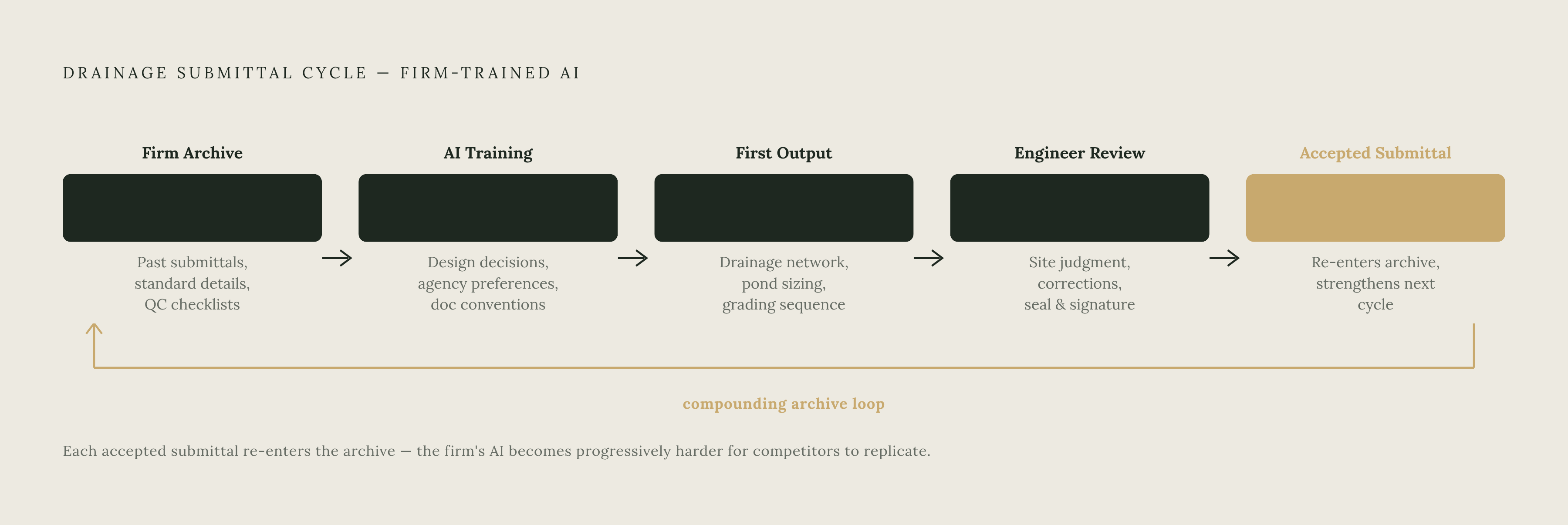
Each completed project adds material that can make the trained AI more closely reflect the firm’s standards. More agencies, project types and accepted documentation formats broaden the range of precedents available for the next job. Review keeps that accumulation useful. As engineers validate outputs and refine the training material, the system’s starting point can move closer to a finished, reviewable deliverable. The advantage develops through the combination of project history and the judgment applied to it.
A generic model remains equally available to competing subscribers, but a firm-specific archive is not a shared resource. It holds years of accepted submittals, ties with agencies and calculation standards improved over time. Firm size does not substitute for that history. A small or mid-size firm can therefore build a durable distinction around its own drainage practice even when a larger competitor has access to the same platform tools. The distinction is not exclusive access to AI, but exclusive access to the experience that shapes its output.
Waiting until the archive is “complete” postpones both training and the process of refining it through engineer review. Firms that begin earlier can accumulate a more developed dataset and production rhythm while later entrants are still establishing their baseline. The durable asset is not the generic model or the subscription, but the firm’s own archive of how it designs drainage.