Will AI Replace Civil Engineers
AI will automate drafting, not the licensed judgment engineers sell.
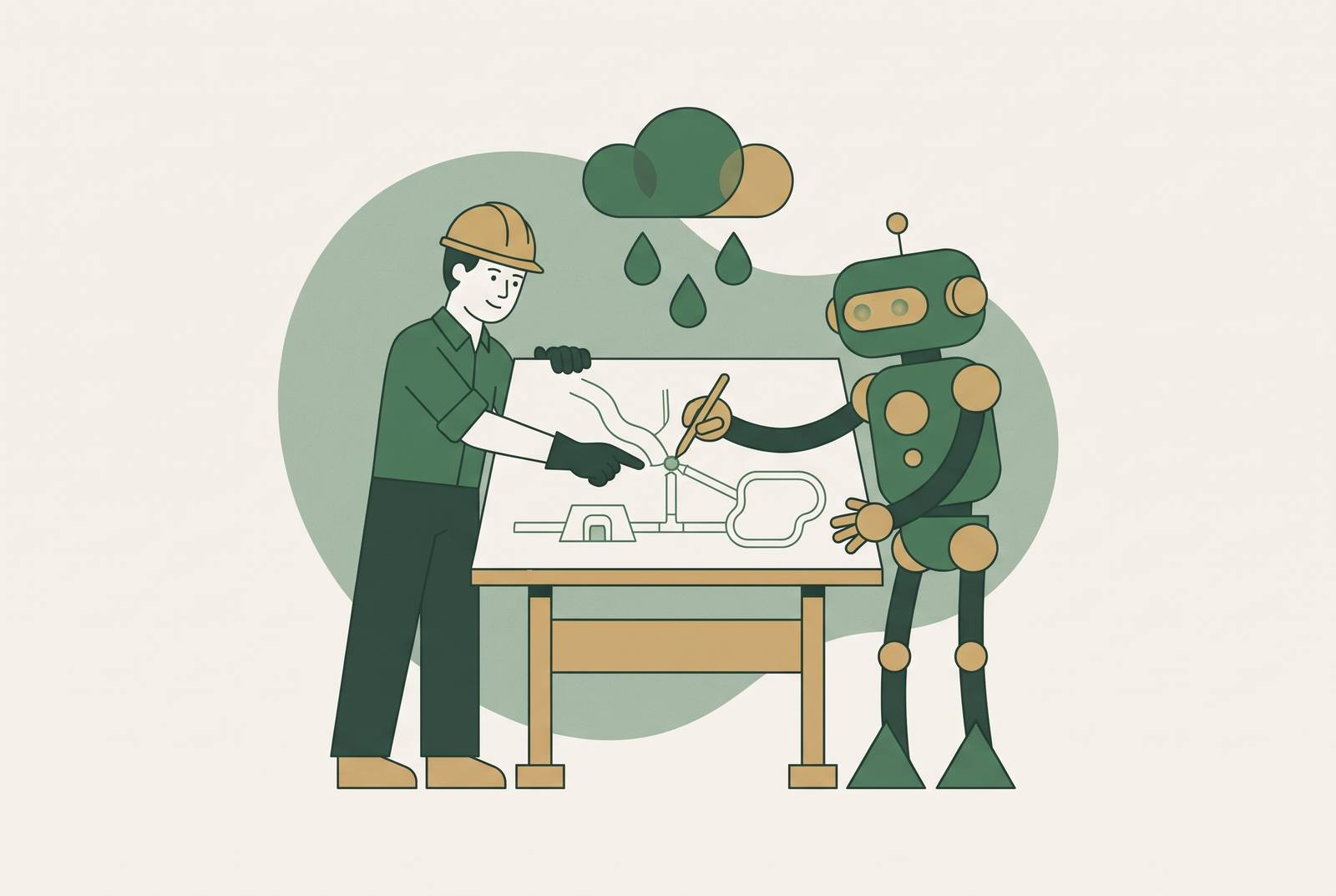
AI is automating drafting, routine analysis, and standard reports, with civil engineers remaining in the profession over the next five to ten years. People are still responsible for licensed judgment, accountability, and project coordination. The greater competitive threat is a smaller team of AI-equipped engineers delivering work faster than firms that continue to rely on manual production.
Why the "replacement" question is the wrong frame for civil engineering
The question “will AI replace civil engineers?” incorrectly treats an occupation as a single activity. A civil engineer’s job combines tasks that follow established rules with decisions that require experience, negotiation, and responsibility for the result. Automating one part does not transfer the whole role to software.
Distinguishing tasks being automated from those left to the engineer is more useful. This distinction matters because civil engineering technicians do more production work than civil engineers and face a greater risk of having that work automated. They work in the same discipline but do not have the same risk profile. The dividing line runs between the production layer, where engineers prepare and process work, and the judgment layer, where they decide what is appropriate and accept responsibility for it.
What the production layer of civil engineering actually looks like — and what AI can do there today
Drafting, standard analysis, document review, and compliance checking are all part of production work. These activities occupy much of a junior engineer’s or technician’s day. Their repetitive structure also makes them suitable for automation. Drawing revision comparison provides a concrete example of AI improving an established workflow.
Martin-Harris Construction used Bluebeam Max’s Smart Overlay and Smart Review during the product’s beta to compare drawing revisions for pricing and impact analysis during design and construction. The task stayed the same. The tools removed manual hunting for changes, allowing staff to focus on their consequences. Director of Preconstruction James Miranda described the value as the ability to “instantly see what's changed and where to focus”.
Generative design extends this approach to repetitive layouts, structural sizing, and duct/conduit routing. Teams set constraints and objectives, AI generates code-aligned, constructible options, and engineers validate them. AI can also help with submittal review, proposal writing, and compliance checking. Even a draft that follows firm standards needs someone qualified to check that it fits the project and approve it.
Autodesk’s AU26 announcements bring more of these tools into software that engineers already know. Civil 3D is becoming a Forma Connected Client, Autodesk Assistant answers natural-language questions about project sites, and Building Layout Explorer generates and compares multifamily layouts against a client’s unit mix. The strongest gains remain in structured, repetitive tasks. Judgment-intensive work produces smaller, and sometimes negative, returns, so faster production should not be mistaken for uniformly better engineering.
What AI cannot yet do — and why licensed accountability creates a hard ceiling on displacement
On-site supervision, complex project coordination, regulatory negotiation, and stamped professional accountability differ from drafting in more than how hard they are. They involve responsibility that software cannot assume. A PE stamp represents legal accountability, and that accountability cannot be delegated to an AI system. AI output must go through professional review and approval before it is used in licensed work.
That obligation is more than a final signature. Design decisions must weigh what different stakeholders want, the conditions at the site, how regulations apply, and the professional risks. A plausible answer is not sufficient. Autodesk makes the distinction explicit in its statement that “In the Design and Make industries, oftentimes, 'probably right' is still wrong”. The engineer must check that the output fits the project even when it looks complete.
ASCE’s Policy Statement 573 says AI “cannot replace the training, experience, and judgement of a professional engineer.” For the next five to ten years, licensed civil engineering is therefore augmentation territory. AI can support judgment without becoming the party responsible for it.
The same distinction applies to physical execution. Robots can already do repetitive or hazardous construction tasks under supervision, while whole workflows that run with little human help remain a mid-to-long-term prospect. Supervised automation is not autonomous project delivery. Improvements in prediction, modeling, and execution do not by themselves resolve who interprets conflicting requirements or accepts the professional risk.
The risk that is actually real — engineers who adopt AI pulling ahead of those who don't
Professional accountability protects the engineer’s function, but it does not protect a firm’s competitive position. Another firm still needs licensed engineers. It may simply need fewer production hours to deliver the same scope, giving it room to price more competitively, accept more projects, or improve margins.
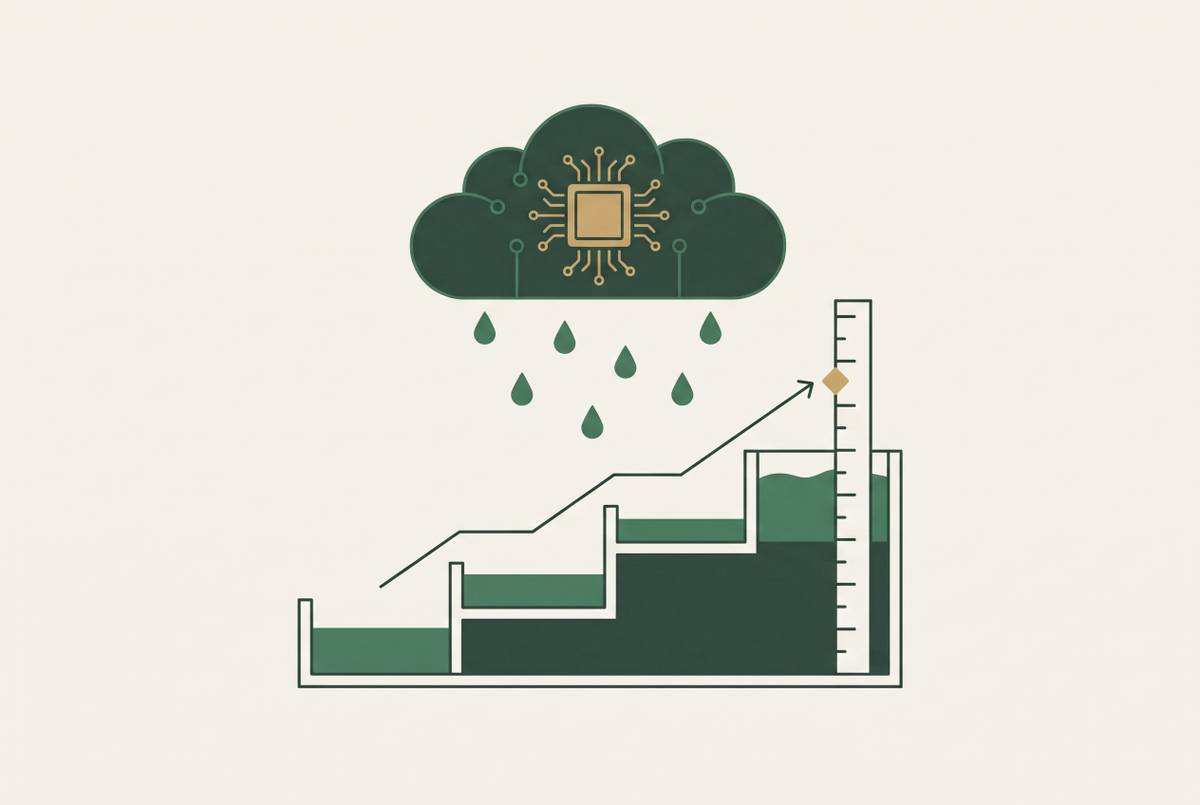
Bluebeam’s 2026 AEC Technology Outlook found that 68% of firms already using AI had cut costs by at least $50,000. Nearly half, 46%, had saved 500–1,000 hours, and nearly all planned to expand usage in 2026. These findings concern only adopters. They nevertheless show that the competitive advantage is already more concrete than a promise of future productivity.
For small and mid-size AEC firms, size can be an advantage at this stage. A nimble firm can adopt in a quarter what a large firm spends years debating. To gain from a model, a firm must change how it works as well as pay for access. As more firms make gains in design, modeling, and construction-feasibility workflows, clients will find more firms that can deliver the same work with less production effort.
An engineer’s value will depend partly on how well that person pairs technical judgment with faster production. Professional competence remains essential, but it is not the only differentiator.
A hidden cost of automating the production layer — the junior engineer pipeline
The production tasks most exposed to automation also teach engineers how to practice. Drafting, routine analysis, and standard report writing develop pattern recognition through repeated contact with technical problems. They are not just deliverables. They are part of how a junior engineer acquires the judgment needed to review someone else’s work later.
Junior staff may advance in title without gaining the underlying competence that production work once demanded. Expertise can then concentrate in a smaller group of senior professionals, leaving the firm more dependent on the people who can challenge an AI-generated result. Faster delivery can coexist with a more fragile workforce.
Firm leaders need to redesign learning deliberately. Planned technical reviews, clearly written standards, simulation exercises, and time set aside for mentorship can take the place of learning that once happened along the way. These activities belong within the adoption effort. Keeping a person responsible for key approvals only works over the long term if the firm continues developing people qualified to give them.
Why most AEC firms haven't adopted AI yet — and what actually stops them
Most AEC firms are not yet using AI in their operations. The same Bluebeam report, based on a global survey of more than 1,000 AEC professionals, found that roughly a quarter were doing so. Adoption is still uneven. Those gains come from a smaller group of users, while far more firms are still weighing the tools, running pilots, or waiting.
That hesitation is not simply resistance to change. Until recently, many available tools asked firms to change how they worked, leaving work already in progress unimproved. The Max beta showed a different route. Firms gained more when they treated adoption as a process of starting with an existing workflow, removing manual friction, and expanding from there.
Data trust presents another barrier. Firms need clarity about ownership, compliance, and liability before committing project work to a system. The beta experience showed greater trust in the platform layer than in the underlying model layer because firms understood what the platform did with their work. Familiarity with a working environment can therefore influence adoption as much as the model’s capabilities.
A large share of AEC firms devote only a small fraction of their technology budget to training, leaving licensed tools underused. Access alone does not change established habits.
How to actually adopt AI inside a civil engineering firm — the sequence that works
Start with one high-value workflow whose results can be measured. Priority belongs to areas with high cost, schedule, and risk variability, especially where performance depends heavily on a small number of experts. Estimating, constructability review, document compliance, and revision comparison are strong candidates.
The first test should improve work the firm already performs. Martin-Harris took this approach with its revision-comparison workflow. It needed less manual searching within a process already required for pricing and impact analysis, making the value of the change easy to recognize.
Next, form a small cross-functional pilot group. Include a designer, a project manager, someone from marketing, someone from finance, and at least one skeptic. Give the group 90 days to test real uses and report what actually saved time. Keep the pilot narrow enough to measure clearly, with people responsible for key approvals throughout.
Training then needs a place inside the technology budget. Treat it as a required part of the implementation work. Making engineers give up Civil 3D, Revit, or the workflows they know creates resistance that a change management program cannot fully overcome.
A successful pilot provides a basis for extending use while maintaining professional review and deliberate staff development. Organizational readiness and workflow integration are central to that decision. For a specialized firm, the strongest opportunity is to amplify work it already does well rather than use AI as a reason to become a different business.
What the civil engineer's role looks like when AI handles the production layer
When AI performs more production work, the engineer’s contribution shifts toward defining the problem and judging the result. Setting constraints matters more because they shape the options that automation produces. Reviewing output requires technical depth. Coordination and accountability remain central because a generated design still has to satisfy the people, conditions, and requirements governing a real project.
Allplan’s 2026 AEC trends analysis describes AI agents that can understand a design problem and operate multiple software tools autonomously. It says these agents aim to cut manual setup and repetitive modeling for professionals who work on complex problems. That is a change in how work gets produced. It is not a transfer of the licensed engineer’s responsibility to an autonomous decision-maker.
Autodesk’s direction toward “outcome-based design” gives this role a practical shape. Teams begin with project goals and use automation to explore options earlier, leaving engineers more time for decisions and less time rebuilding context between tools. Production becomes a means of testing choices. The engineer determines which options deserve further development and where a model has missed something consequential.
The most valuable engineers will combine that capacity with critical review and responsibility for what gets stamped and built. Their advantage will not rest on producing every calculation or drawing personally. It will rest on directing more work without surrendering technical control. The profession’s forward path is an engineer setting the right constraints, testing more alternatives, and applying informed judgment to the decisions that shape what gets built.
Sources
- How Autodesk Forma and AI are advancing a more connected future for AEC
- How agentic AI is transforming the AEC industry
- How is the architecture, engineering and construction (AEC) industry adopting artificial intelligence? A cross-sectional survey study - ScienceDirect
- A Primer on AI Integration for Engineering Firms from the ...
- Architecture, engineering, construction sector slow to adopt AI, survey shows